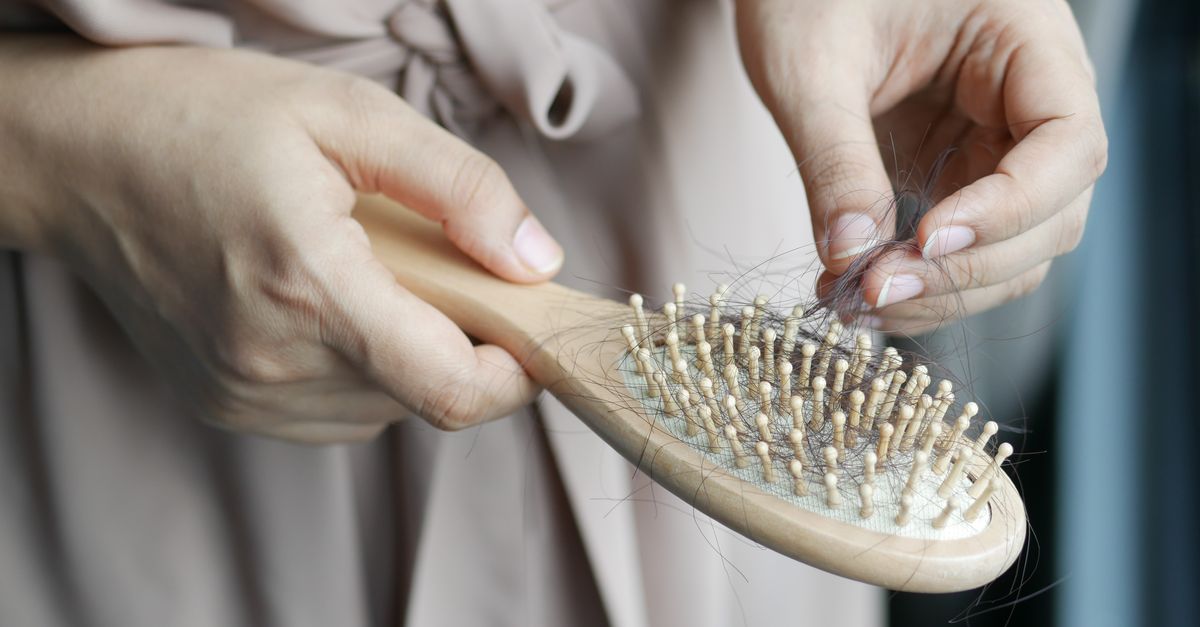
Shedding during weight loss is usually telogen effluvium: a metabolic shock pushes an unusually large share of follicles into their resting phase early, and they release together about three months later. The trigger is normally the size and speed of the deficit, and what the diet left out. In most cases it is temporary.
What is actually happening to your hair?
Every follicle runs its own cycle rather than moving in step with its neighbours. Most are growing at any given moment, a smaller share are resting, and resting hairs are pushed out when the next growth phase starts underneath them. This is why losing hair daily is normal rather than a warning sign. The NHS puts the usual figure at between 50 and 100 hairs a day, most of which nobody notices.
A sudden metabolic stress interrupts that staggered pattern. A large group of growing follicles switch into the resting phase at roughly the same time, sit there for a couple of months, and then come out together. The result is diffuse thinning across the whole scalp rather than distinct bald patches, and it shows up first in the shower drain, on the pillow and in the brush. The clinical name for it is telogen effluvium.
The mechanism matters mainly because of what it says about timing. Hair coming out today stopped growing weeks ago. What you are looking at is a record of something that has already happened, not a report on what you ate this week.
Why does the shedding start months after the diet did?
Telogen effluvium typically produces visible shedding around three months after the triggering event, though it can begin sooner. In one documented case following weight loss surgery, diffuse hair loss was noticed within seven weeks.
That delay causes most of the confusion around this. By the time hair starts coming out in handfuls, the aggressive phase of the diet is often over, so people hunt for a cause in the past fortnight: a new shampoo, hard water, a supplement, a colour treatment. The actual trigger is months upstream and no longer feels connected.
The lag runs in the other direction too, and that is the part worth preparing for. Correcting the diet today does not stop the shedding today. Follicles already committed to the resting phase still release on their own schedule, so shedding usually continues for a while after the thing that caused it has been fixed.

How common is this, and who does it happen to?
Ordinary dieting is hard to study here, because almost nobody reports hair shedding to anyone who records it. The clearest numbers come from an extreme version of the same stimulus, weight loss surgery, where patients are followed closely.
A systematic review and meta analysis in Obesity Surgery pooled 18 studies covering 2,538 patients and found hair loss in 57 percent of them, with a confidence interval of 42 to 71 percent. Younger age, female sex, and low ferritin, zinc and folate levels were all associated with it. Serum iron and vitamin B12 levels were not. Reported incidence also fell with time since surgery, from 58 percent within the first year to 35 percent at a year or more, which is roughly what a self limiting problem looks like in data.
Surgery is not the same as eating less at home, and those percentages should not be read as personal odds. What carries across is the shape of the finding. Bigger and faster deficits produce more shedding, poor micronutrient status makes it more likely, and it eases as things settle.
Is it the weight loss, the speed, or what the diet leaves out?
Mostly the second and third. Weight coming off is not itself a signal to a follicle. Severe restriction is. The hair matrix has one of the highest rates of cell turnover of any tissue in the body, which makes it unusually sensitive to a sharp drop in available fuel and raw material, and it is not a tissue the body prioritises when supply is short.
| Factor | What the evidence supports | What it means in practice |
|---|---|---|
| Speed of the deficit | Rapid loss is the common thread in reported cases | The single factor most within your control |
| How low intake goes | Severe restriction, not the weight change, is the trigger | Eating enough matters more than the number on the scale |
| Protein intake | Hair is keratin, and protein is diverted elsewhere when intake is low | Keep protein high while calories are low |
| Ferritin, your iron stores | Low ferritin was associated with shedding after surgery | A blood test answers this, guessing does not |
| Zinc and folate | Both associated in the same analysis, though wider data are mixed | Test before supplementing, not after |
| Age and sex | Younger patients and women were affected more often | Not modifiable, but useful context |
| Thyroid or iron deficiency | Both cause shedding independently of any diet | A reason to see a doctor rather than adjust the diet again |
The useful thing about that list is that the modifiable factors sit at the top and the measurable ones sit in the middle. None of it responds to trying harder.
Do iron, zinc, biotin or vitamin D supplements fix it?
This is where most of the money goes and where the evidence is thinnest. A review of vitamins and minerals in hair loss in Dermatology and Therapy worked through the individual nutrients, and its conclusions are a good deal less encouraging than the marketing built on them.

Biotin is the clearest case. Biotin deficiency does cause hair loss, and that review found no evidence based data that supplementing biotin promotes hair growth in people who are not deficient. It also flags a practical hazard: biotin interferes with a number of common laboratory assays and can produce false results, so a hair supplement taken before blood work is capable of sending an investigation the wrong way.
| Nutrient | What that review supports | Reasonable reading |
|---|---|---|
| Iron and ferritin | Supplementation is widely agreed on where there is a deficiency, but evidence that replacement improves telogen effluvium is insufficient | Correct a measured deficiency, do not expect it to be the whole answer |
| Zinc | Data linking zinc levels to shedding are not consistent, and routine screening is not recommended | Not a default purchase |
| Vitamin D | Supplementation is agreed on where a deficiency is present | Worth testing if there is reason to suspect it |
| Biotin | No evidence based data that it promotes hair growth without deficiency, and it distorts some blood tests | Little to gain, and a real reason to avoid it before testing |
| Selenium | Selenium toxicity causes hair loss | More is not safer |
| Vitamin A | Excess vitamin A causes hair loss | Stacked products can overshoot |
Two things follow. Testing beats guessing, because the nutrients with the strongest case for treatment are precisely the ones that can be measured. And more is not safer: a shelf of overlapping hair, skin and nail products is genuinely capable of causing the problem it was bought to solve.
What actually changes the odds?
There is no version of this in which a product shortens the resting phase. What is left is unglamorous, and most of it is about the size of the deficit rather than the contents of a bathroom cabinet.
- Make the deficit smaller rather than deeper. A slower rate of loss is the lever that consistently exists.
- Keep protein up while calories are down. Hair is built from protein, and it is not what the body protects first.
- Ask for blood tests instead of buying supplements blind. Ferritin and thyroid function are reasonable things to raise with a doctor.
- Avoid biotin in the weeks before blood tests, and tell whoever ordered them what you are already taking.
- Do not read the first few weeks as a verdict. Shedding that began three months ago will not stop three days after the diet improves.
- Keep the range of food wide enough that micronutrients are not what you end up economising on.
When is this worth a doctor’s appointment rather than another diet change?
The NHS lists weight loss and iron deficiency among the causes of temporary hair loss, and says hair loss caused by a medical condition usually stops or grows back once you have recovered. It also advises seeing a GP if the hair loss is worrying you, and doing that before paying a commercial hair clinic.
Some features point away from a straightforward diet related shed, and they are worth raising with a doctor rather than assessing at home: distinct bald patches instead of even thinning, a hairline or parting that has been changing slowly over years, scalp pain, itching, scaling or smooth areas where the skin itself looks altered, shedding that carries on well beyond six months, or shedding alongside symptoms such as persistent fatigue, feeling cold, or changes to periods. Thyroid disease and iron deficiency both cause hair shedding in their own right, and both are ordinary blood tests. Our piece on what hypothyroidism does to the body covers the first of those, and slow metabolism and PCOS covers another hormonal route to the same complaint.
The honest summary is that this is common, that it usually reflects how fast the weight came off rather than a hidden illness, and that the things which help are the ones nobody wants to hear: a smaller deficit, enough protein, and time.
Frequently asked questions
Will my hair grow back?
In most cases yes. Telogen effluvium is a shedding of hairs that were pushed early into the resting phase, not damage to the follicle itself, and the NHS notes that hair loss caused by a medical condition usually stops or grows back once you have recovered. Regrowth is gradual and the new hair is often short and fine at first.
How long does the shedding last?
Longer than most people expect, because the trigger and the shedding are separated by roughly three months in both directions. Shedding continuing for some weeks after the diet is corrected is normal. Shedding that is still heavy well past six months is worth taking to a doctor rather than waiting out.
Does losing weight more slowly prevent it?
It lowers the risk rather than removing it. The consistent pattern in the evidence is that faster and more severe restriction is associated with more shedding, so a smaller deficit with adequate protein is the most useful adjustment available. It is not a guarantee, since nutrient status and other health conditions also play a part.
Should I take biotin for it?
There is no evidence based support for biotin promoting hair growth in people who are not deficient, and biotin interferes with several common blood tests, which can distort results including thyroid ones. If blood tests are being considered, that is a reason to mention any biotin you are taking rather than to start it.
Is hair falling out during weight loss a sign something is seriously wrong?
Usually not. It is a recognised and common response to a sharp reduction in intake. It is still worth a conversation with a doctor, because thyroid problems and iron deficiency cause the same symptom, both are easy to test for, and neither improves by changing the diet again.
How is this different from pattern hair loss?
The pattern and the pace differ. Diet related shedding is diffuse, comes on over weeks and affects the whole scalp. Pattern hair loss develops slowly over years in a characteristic distribution and does not resolve on its own. Telling them apart is a job for a doctor who can look at your scalp, not for an article.
This article is general information, not medical advice, and is not a substitute for care from a qualified healthcare professional. Speak to your doctor about hair loss, weight or any other concern of your own.
Leave a Reply